Perhaps no animal in the world has been misunderstood as much as the elephant. These giant herbivores are the largest land animals alive today, but what do we actually know about elephants? Surprisingly little. To begin with, many people mistakenly consider the mammoth to be an ancestor of the elephant. But this is not quite correct. Mammoths, mastodons, and modern elephants belong to different branches of the proboscidean family tree. Some of the animals below are early relatives or evolutionary side branches rather than direct ancestors. So who are the remarkable members of the elephant family tree? Let’s take a look.
1 Eritherium (about 60 million years ago) 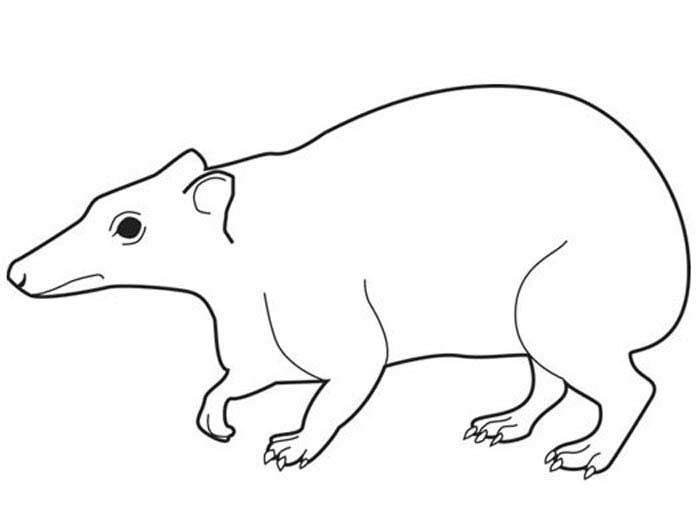
The earliest relatives of elephants were certainly not giants. They did not have anything resembling the trunk of a modern elephant either. One of the oldest known proboscideans is Eritherium. This tiny mammal weighed only around 3–8 kilograms. It is known from fragmentary fossils, including parts of the jaw, but its teeth provided important evidence that it belonged to the early proboscidean lineage.
2 Phosphatherium (about 56 million years ago) 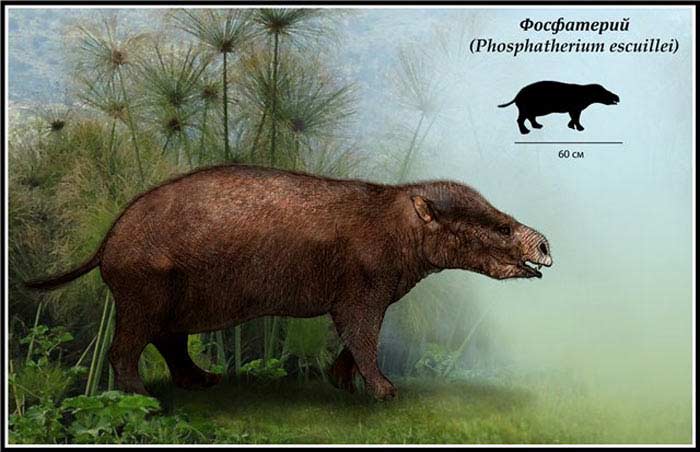
Phosphatherium was another very early proboscidean and one of the first known members of the group after Eritherium. It was still tiny compared with modern elephants, although estimates of its exact size are uncertain because the fossil record is fragmentary. Its anatomy shows that proboscideans were still small mammals at this early stage of their evolution. Unlike modern elephants, it was probably an opportunistic feeder rather than a specialized grazer or browser.
3 Moeritherium (about 37–35 million years ago) 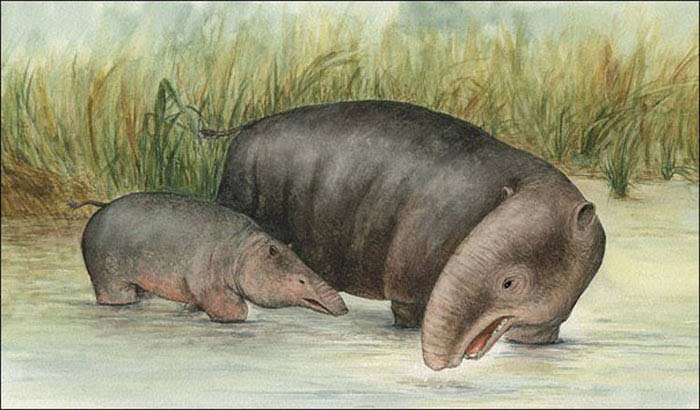
A semi-aquatic animal that lived around the edges of lakes and other bodies of water, Moeritherium already showed some features that foreshadowed later proboscideans. It had enlarged incisor teeth, which were early versions of the structures that eventually evolved into elephant tusks. It was still much smaller than a modern elephant, standing roughly a metre tall at the shoulder and weighing perhaps a few hundred kilograms.
4 Barytherium (about 37–33 million years ago) 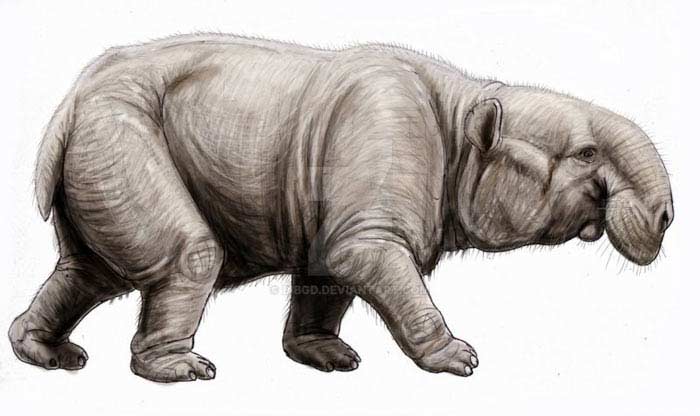
Much larger than the earliest proboscideans, Barytherium had a massive body and an unusually large skull. It possessed several enlarged incisors that projected from both the upper and lower jaws, giving its face a distinctly strange appearance. Some species reached considerable sizes for their time, with estimates approaching two tonnes. If you encountered one, it would certainly have looked very different from the familiar elephants of today.
5 Palaeomastodons (about 36–35 million years ago) 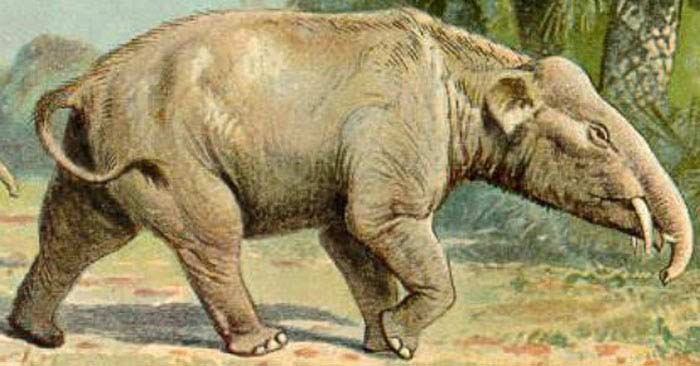
Around this period, Palaeomastodon was also living in Africa. These animals already displayed several recognizable proboscidean features, including a relatively elephant-like body, a large skull, and elongated incisors that functioned as tusks rather than ordinary chewing teeth. Their lower tusks were broad and shovel-shaped, and they may have been used to pull up or gather vegetation and other food close to the ground.
6 Deinotherium (about 20–2 million years ago) 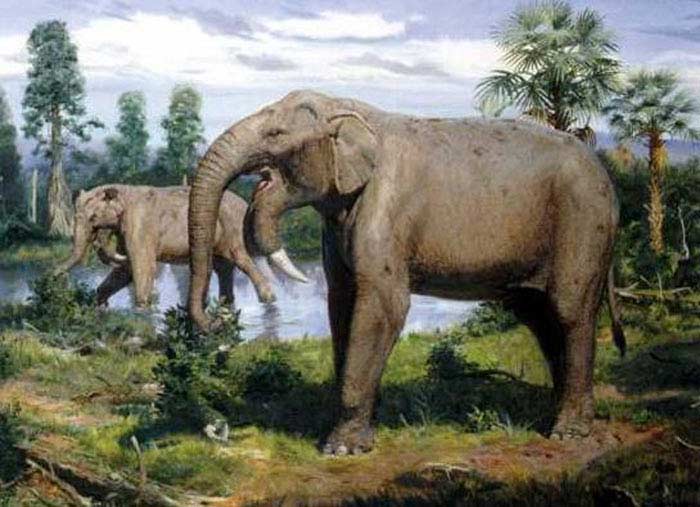
Strictly speaking, Deinotherium was not a direct ancestor of modern elephants. It belonged to a separate branch of the proboscidean family tree that survived for millions of years. These animals were enormous, with some species reaching around 4 metres at the shoulder. Their most striking feature was a pair of tusks that curved downward from the lower jaw. Deinotherium survived until roughly 2 million years ago, meaning that early humans may have encountered its remains, although there is no evidence that humans actually saw living Deinotherium.
7 Platybelodon (about 15–4 million years ago) 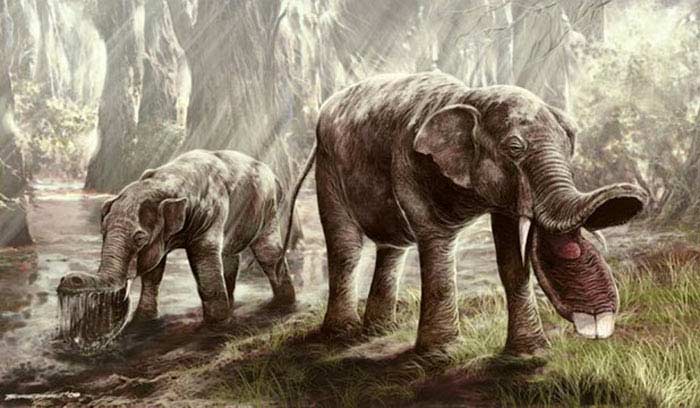
Another unusual branch of the proboscidean family tree was Platybelodon. It had elongated, shovel-like lower jaws and broad lower tusks that gave its mouth a bizarre appearance. These structures may have helped it gather vegetation from the ground or wetlands. Fossils of Platybelodon have been found across a wide area of Africa, Eurasia, and North America, showing how widely some proboscideans spread during the Miocene.
8 Gomphotherium (about 15–5 million years ago) 
Imagine giving an elephant four tusks, including a pair extending from the lower jaw, and you get something that looks much like Gomphotherium. These animals were widespread during the Miocene and included species that were similar in size to modern elephants. Their lower jaws were elongated and carried tusks, while the upper tusks projected forward. Unlike modern elephants, their dental anatomy was adapted to a different style of feeding, and many species were browsers or mixed feeders.
9 Stegodons (about 11–0.012 million years ago) 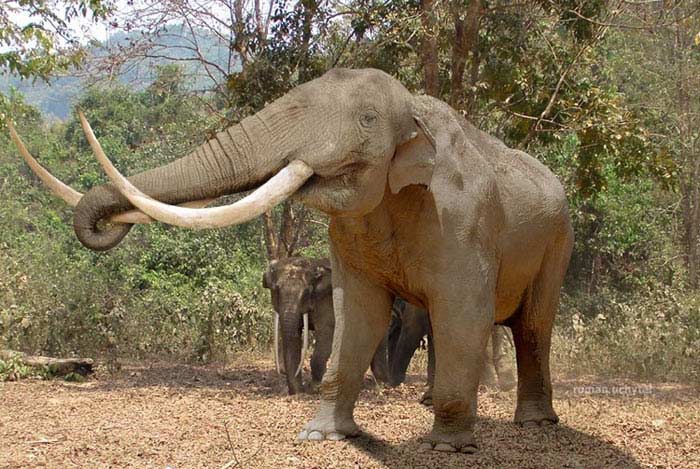
Stegodons were a diverse group of elephant relatives that could reach enormous sizes. Some species stood around 4 metres tall, and their long tusks could make them particularly impressive animals. Stegodons survived surprisingly late in parts of Asia. On the Indonesian island of Flores, a dwarf form survived until roughly 12,000 years ago and lived alongside Homo floresiensis, the so-called “hobbits.” This makes Stegodon one of the most remarkable late survivors among the ancient elephant relatives.
10 Primelephas (about 5–1 million years ago) 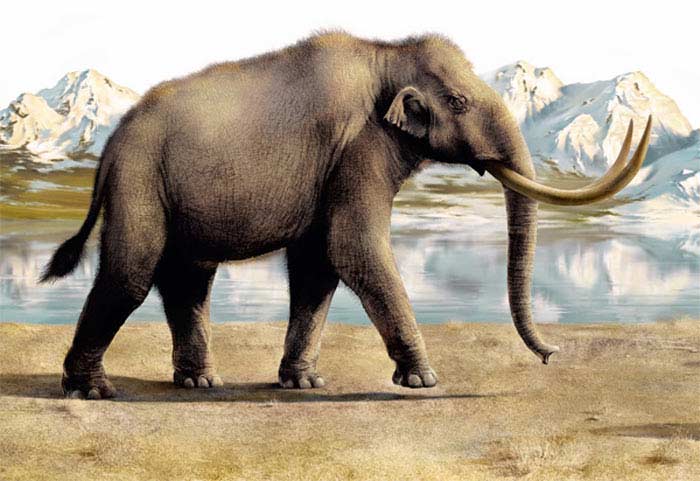
And finally, we come to Primelephas, a genus much closer to modern elephants than most of the animals on this list. The name means “first elephant,” although it was not literally the first elephant. Primelephas is generally considered to have been close to the common ancestry of the elephantid lineages that later gave rise to mammoths and living African and Asian elephants. It had four tusks, including lower tusks, a feature that disappeared in its later descendants. From this point, the evolutionary branches leading to modern elephants and mammoths became increasingly distinct.